Department of Artificial Intelligence, Korea Universitywoohyeok_choi@korea.ac.kr
AI Researcher - Neural Engineering - Brain Decoding / AI in Epilepsy
About
I am a Ph.D. candidate in the Department of Artificial Intelligence at Korea University.
My research lies at the intersection of machine learning, neural engineering, and clinical neuroscience, with a particular focus on AI for epilepsy and brain decoding.
I develop machine-learning methods for biomedical signals with the goal of advancing neural engineering research and translating these approaches into practical clinical decision-support workflows.
I am always happy to connect with others who share similar research interests. Please feel free to reach out.
News
Selected for the 2027 University of Toronto AI Convergence Education Program
Selected as a visiting trainee for the six-month AI convergence program at the University of Toronto, administered by Sogang University's Global AI Education Center with support from IITP and the Ministry of Science and ICT.
Homepage refreshed
Research updates, publications, awards, and patent records are being organized here.
A comparative study on the influence of undersampling and oversampling techniques for the classification of physical activities using an imbalanced accelerometer dataset
Dong-Hwa Jeong, Se-Eun Kim, Woohyeok Choi, Seong-Ho Ahn
2023
2023 AI Voucher Support Project
Ministry of Science and ICT / IITP
Project
2022
2022 Data Voucher Support Project
Korea Data Agency
Project
2021.12
[First Prize] Forest Tree Data Online Hackathon
Korea Information Society Promotion Agency
Award
2021.02
[First Prize] Solar Power Generation Prediction AI Competition
DACON
Award
2021
Development of a CFD-Based Wind Tunnel Experiment Prediction Model
The Catholic University of Korea / Englink Co., Ltd.
Outsourcing
2021
Barrier-Free Subtitle Production Automation System
OROT PLANET
Outsourcing
Patents
2026
Apparatus and Method for Cross-Subject EEG-Based Visual Brain Decoding Using Semantic Soft Alignment and Subject-Aware Batch Normalization
Songha Kim, Jun-Mo Kim, Woohyeok Choi, Tae-Eui Kam
Patent Application
2025
Deep Learning-Based Method for Predicting Epileptic Seizures with Minimal Electrodes Considering Epileptic Onset Location
Woohyeok Choi, Tae-Eui Kam
2024
Deep Learning-Based Method for Predicting Epileptic Seizures with Minimal Electrodes Considering Epileptic Onset Location
Woohyeok Choi, Tae-Eui Kam
Patent ApplicationKR1020240039590
Deep convolutional gated recurrent unit combined with attention mechanism to classify pre-ictal from interictal EEG with minimized number of channels
Abstract
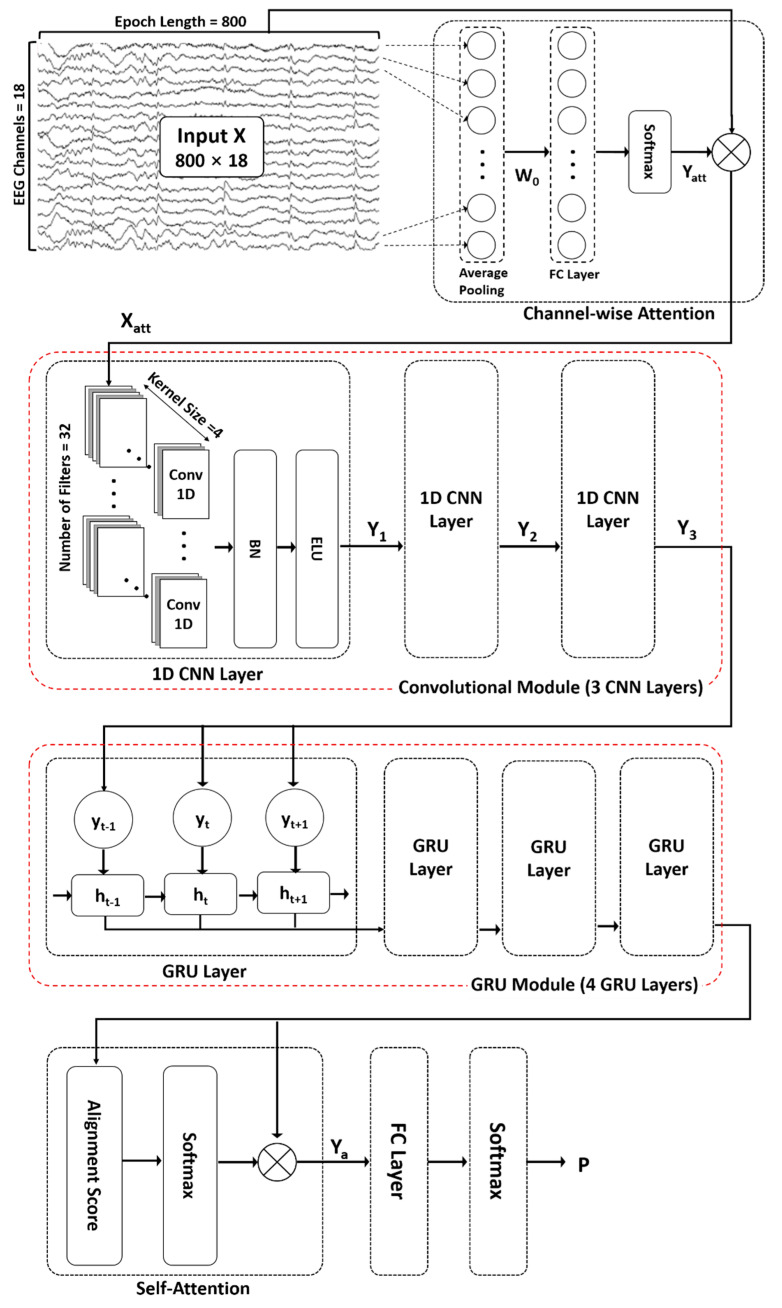
The early prediction of epileptic seizures is important to provide appropriate treatment because it can notify clinicians in advance. Various EEG-based machine learning techniques have been used for automatic seizure classification based on subject-specific paradigms. However, because subject-specific models tend to perform poorly on new patient data, a generalized model with a cross-patient paradigm is necessary for building a robust seizure diagnosis system. In this study, we proposed a generalized model that combines one-dimensional convolutional layers (1D CNN), gated recurrent unit (GRU) layers, and attention mechanisms to classify preictal and interictal phases. When we trained this model with ten minutes of preictal data, the average accuracy over eight patients was 82.86%, with 80% sensitivity and 85.5% precision, outperforming other state-of-the-art models. In addition, we proposed a novel application of attention mechanisms for channel selection. The personalized model using three channels with the highest attention score from the generalized model performed better than when using the smallest attention score. Based on these results, we proposed a model for generalized seizure predictors and a seizure-monitoring system with a minimized number of EEG channels.
Publisher:
Journal of Personalized Medicine
Year:
2022
Topic:
Seizure Prediction
IF:
4.9
JCR:
2020
Category:
HEALTH CARE SCIENCES & SERVICES
Quartile:
Q1
JIF Rank:
15/107
JIF Percentile:
86.45%
Top:
13.55%
EEG-based epileptic seizure prediction with patient-tailored spectral-spatial-temporal feature learning
Abstract
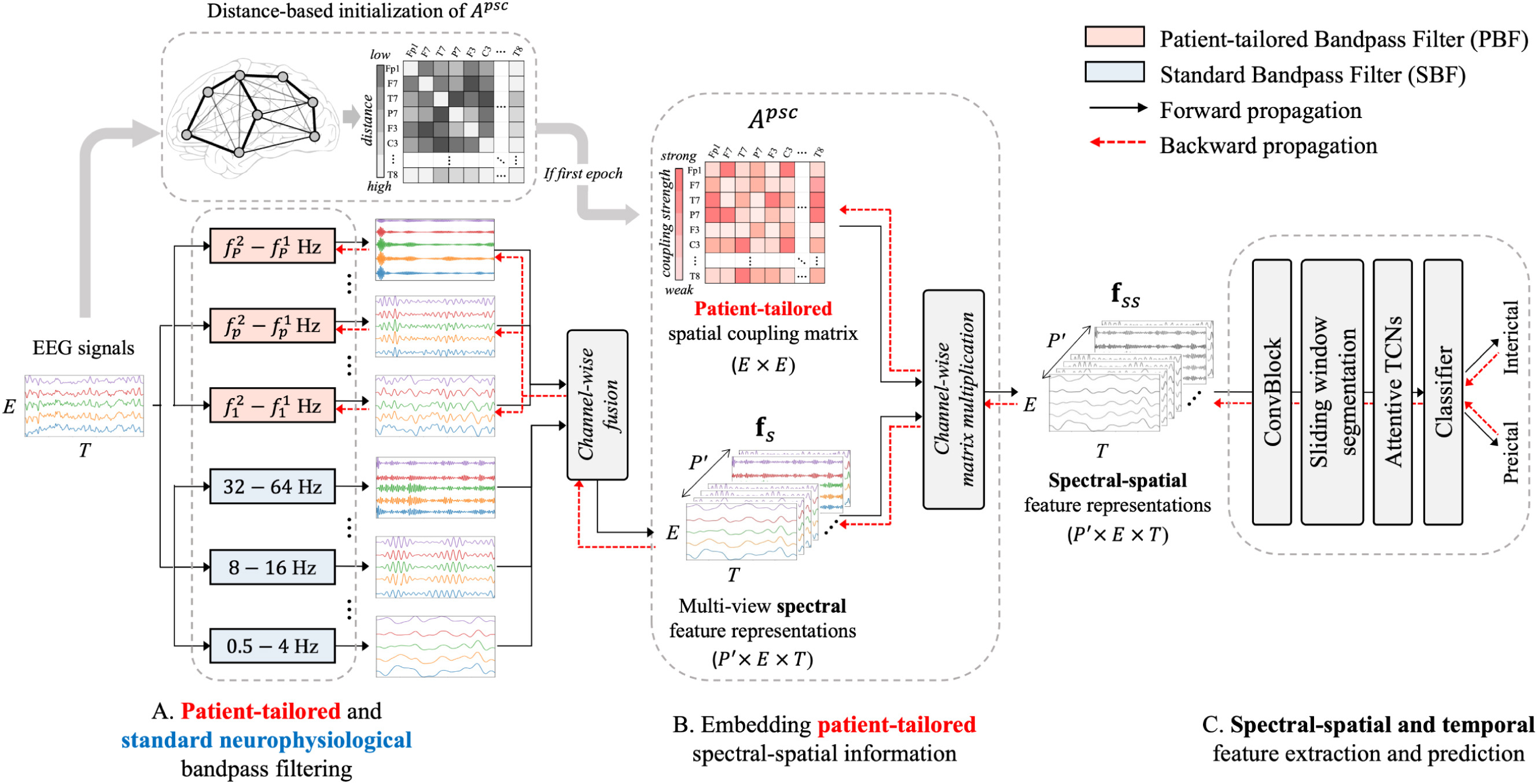
Epilepsy is a chronic brain disorder characterized by recurrent seizures resulting from abnormal brain cell activity. The unpredictability of these seizures underscores the criticality of anticipating and promptly addressing them to enhance the patient’s overall quality of life. Electroencephalography (EEG) is a frequently employed technique for seizure prediction, leveraging its economic viability and high temporal resolution. However, the complexity of EEG signals has driven interest in machine learning and deep learning for automated seizure prediction systems. Nevertheless, conventional approaches that employ predefined methodologies for analyzing seizures may not adequately account for the variability in spectral and spatial characteristics among patients. To address these limitations and present a more effective and interpretable approach, we introduce the patient-tailored seizure prediction network (PSP-Net) for adaptive spectral–spatial–temporal EEG feature representation learning. PSP-Net combines patient-tailored bandpass filters, a patient-tailored spatial coupling matrix, and an attentive temporal convolution network-based feature extractor in a unified framework to automatically extract patient-specific spectral–spatial–temporal features from EEG data. The proposed method achieves state-of-the-art performance on multiple publicly available seizure datasets, which highlights its potential as a reliable tool for personalized clinical applications.
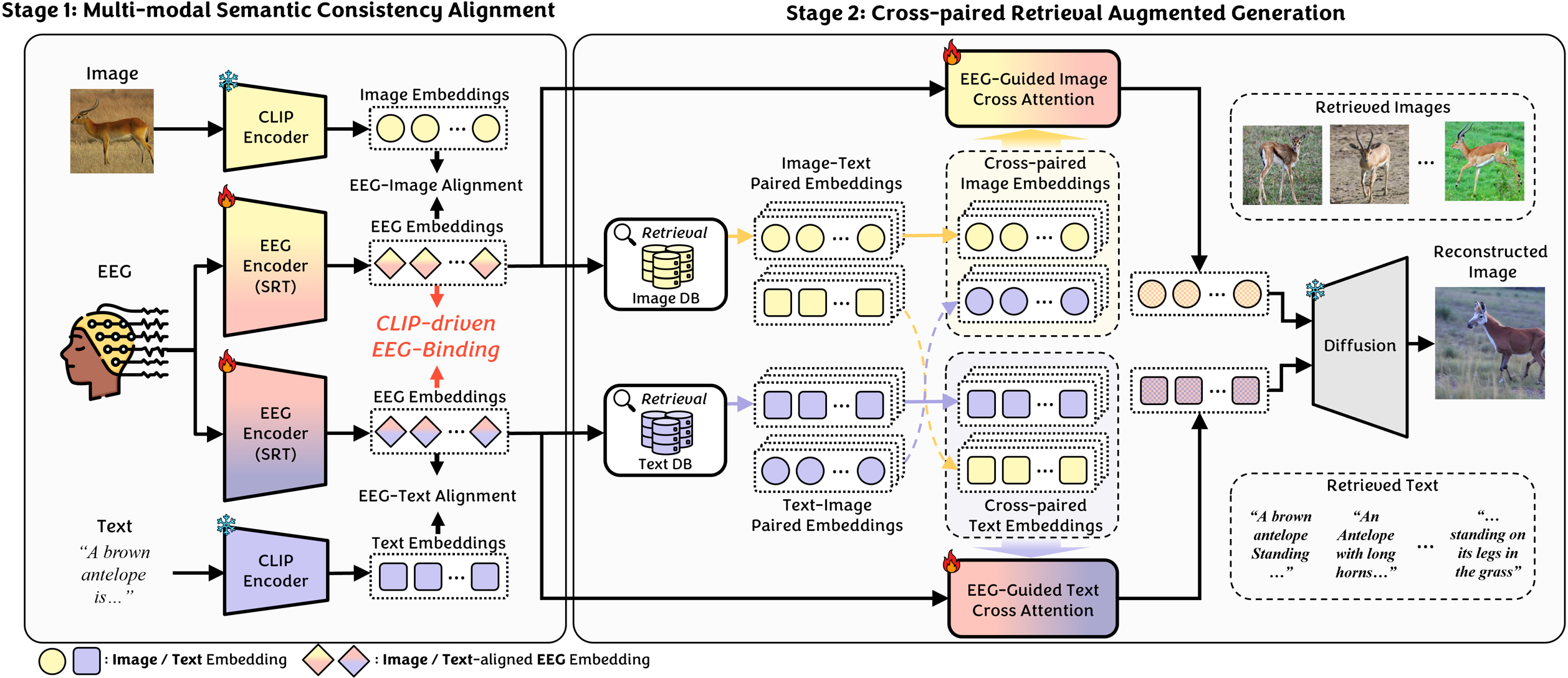
Visual brain decoding aims to understand how humans interpret visual stimuli and to reconstruct the perceived stimuli from brain signals. Electroencephalography (EEG) has emerged as a practical neuroimaging method for real-world applications due to its high portability, low cost, and feasibility. However, reconstructing visual stimuli from EEG remains challenging due to its limited spatial resolution, which hinders the capture of visual semantics and the generation of high-fidelity images. To address these challenges, we propose SeeEEG, an EEG-based retrieval-augmented generation framework for visual perception decoding. Firstly, we introduce a Semantic Region-aware Transformer (SRT) designed to aggregate EEG embeddings at both the electrode and regional levels, maximizing the utilization of spatial information despite EEG's limited spatial resolution. Next, we align EEG embeddings with image and text embeddings, respectively, using contrastive learning to ensure semantic consistency. Then we uses these aligned EEG embeddings to retrieve similar images and text with their pairs from an external image-text database. The EEG embeddings are augmented with retrieved samples via cross attention, enriching their high-level semantics and serving as guidance for a diffusion model to generate high-fidelity images. Experimental results demonstrate that SeeEEG outperforms state-of-the-art EEG-based methods in retrieval and image generation tasks, highlighting its effectiveness in capturing high-level semantics from EEG. These findings underscore the potential of SeeEEG as a robust framework for advancing EEG-based visual brain decoding.
Publisher:
IEEE/CVF International Conference on Computer Vision Workshops (ICCV/W)